
Created by Mike Donghia. Subscribe to our blog for free daily updates.
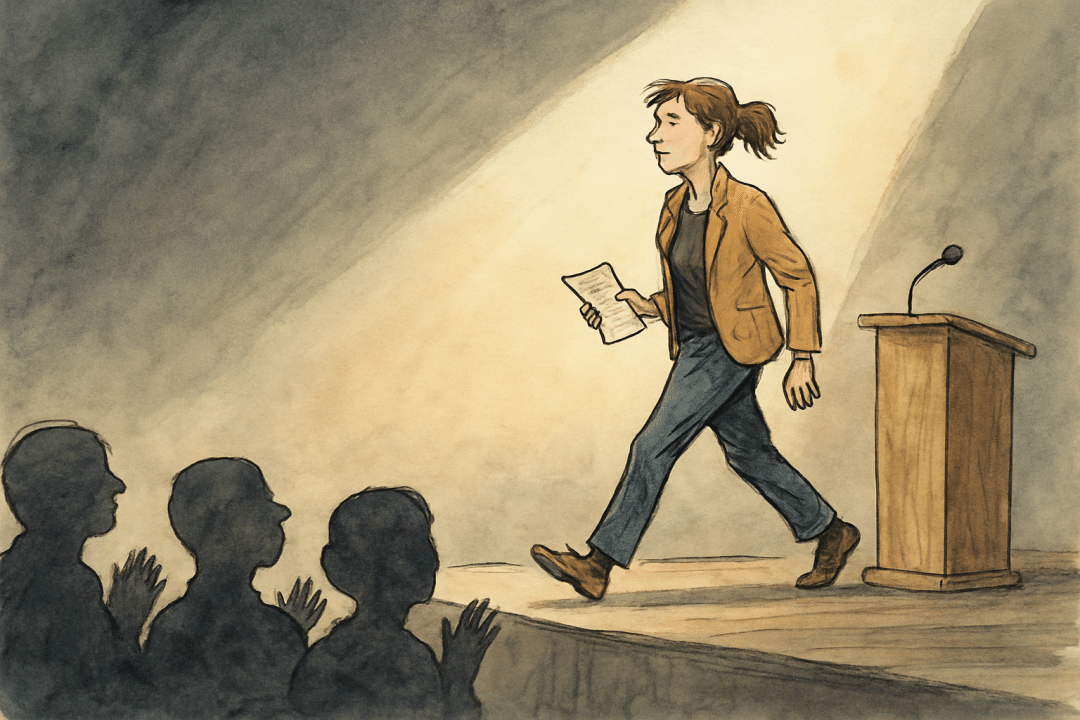
In 1921, a painfully shy Eleanor Roosevelt agreed—against every instinct—to stand before a New York women’s club and deliver her first public speech. Her hands shook so visibly that she gripped the podium to hide them, and the opening paragraphs came out in a near whisper.
Yet when the talk ended, the audience applauded, and she walked offstage with an insight that would shape her life: courage is earned only at the moment of action. Roosevelt went on to log more speaking hours than any First Lady in history, championing civil rights and wartime relief, but she never claimed her fear disappeared. What changed was her reflex; every new engagement reminded her that confidence isn’t a pre-requisite but a dividend.
The nine strategies that follow distill that Roosevelt principle into concrete actions you can run today. Each one pushes you past the planning stall and into motion—because, as her quaking hands proved, bold action is the only reliable on-ramp to genuine self-trust. You can’t think your way through it.
Chase the task that makes your pulse spike—fear is a compass, not a stop sign. Start by listing the duties or ideas you routinely postpone, then circle the one that makes your chest tighten. Commit to a 15-minute “fear sprint” on it each morning before other work claims your attention; the early slot prevents rationalization from gathering strength. Keep a log of sensations—what felt frightening at minute one usually feels merely challenging by minute fifteen. Over weeks, the pattern teaches your nervous system to translate fear’s signal as directional guidance rather than a barricade.
Make uncomfortable requests until “no” loses its sting and “yes” feels inevitable. Draft ten asks that feel slightly outrageous—fee increases, mentorship coffees, project resources—and send one per weekday. Track replies in a spreadsheet, noting both outcome and emotional after-effects. You’ll find that rejection generally arrives politely, costs nothing, and sometimes comes with partial concessions or useful context. The ratio of wins to attempts becomes a practical reminder that silence, not refusal, is the bigger threat to progress.
Compress learning cycles: prototype, fail, and iterate before self-doubt can assemble. Convert big ambitions into sketches, mock-ups, or minimum-viable versions you can finish in a single sitting. Share the draft with a trusted peer or small audience the same day, collect feedback, adjust, and repeat. The rapid loop denies your inner critic the luxury of long deliberation—there’s always another iteration about to begin anyway. Velocity replaces certainty as the core performance metric.
Anchor bold moves to clear values so risk reads like integrity, not recklessness. Write a one-sentence principle—for example, “I pursue work that expands human agency”—and pin it above your desk. When a daring opportunity appears, test it against the principle: if it advances the value, the risk is mission-aligned; if not, decline without regret. This filter prevents you from mistaking impulsiveness for courage and guards against performing boldness for its own sake. Over time the habit builds a reputation for purposeful audacity, which attracts better challenges.
Treat setbacks as data—update the approach, not the identity. After any flop, run a brief post-mortem: what hypothesis failed, what variable surprised you, what adjustment is next? Write the answers in third person (“The project underestimated X”) to keep blame from attaching to self-worth. Implement one concrete change immediately—even a tiny tweak—to convert analysis into real world momentum. The procedure reframes failure from verdict to research note.
Schedule daily “edge reps”: small acts beyond competence that train courage like a muscle. Choose a five-minute task—speaking up first in a meeting, sketching an idea publicly, cold-calling a prospect—and set an alarm for the same time each day. Record completion with a simple check mark; the visual streak turns bravery into a game of consistency. As the reps accumulate, raise difficulty: longer presentations, bigger audiences, higher-stakes pitches. You’ll notice baseline confidence rising the way physical strength does after progressive lifting.
Reframe criticism as free consulting; the harsher the feedback, the higher its ROI. When critiques arrive, copy them into a document titled “Upgrades,” stripping out tone and identifying concrete suggestions. Rank each item by ease of implementation and schedule the top two for immediate action. Thank the critic—even silently—because you’ve just saved the cost of a paid review. By treating detractors as involuntary mentors, you turn antagonism into an asymmetrical advantage.
Outpace perfectionism by setting absurdly short deadlines for first drafts. Decide on a deliverable—proposal, blog post, deck—and give yourself 30 minutes to produce version 0.1, timer visible. The tight constraint pushes you past the urge to polish commas and forces focus on structure and gist. Once the draft exists, extend the deadline only in targeted micro-sprints (10 minutes for fixes, 5 for visuals). The practice separates creation from refinement and proves that speed can be a clarity tool, not a quality tax.
Celebrate completed experiments, not flawless outcomes, so momentum becomes the metric of self-trust. Keep an “Experiments Shipped” journal where every finished attempt—successful or not—earns a dated entry and a brief reflection. Review the list weekly, looking for volume and variety rather than trophies. Share highlights with a friend or team to cement the norm that action itself is praiseworthy. The growing ledger becomes tangible evidence that you are a person who moves, and confidence follows the historical record.
Bold action is the crucible of self-confidence: each fear sprint, audacious request, or rapid prototype transforms anxiety into data and expands the mind’s map of what is survivable. The nine drills above work because they generate proof, not just pep, that you can push past hesitation and adapt. As Johann Wolfgang von Goethe—the German poet, scientist, and statesman—observed, “Boldness has genius, power, and magic in it; begin it now.” Start anywhere, collect the evidence of your own resilience, and watch courage grow from a distant ideal into a daily reflex.
If you enjoyed this article, please support my work by subscribing to my daily newsletter.