Created by Mike Donghia. Subscribe to our blog for free daily updates.
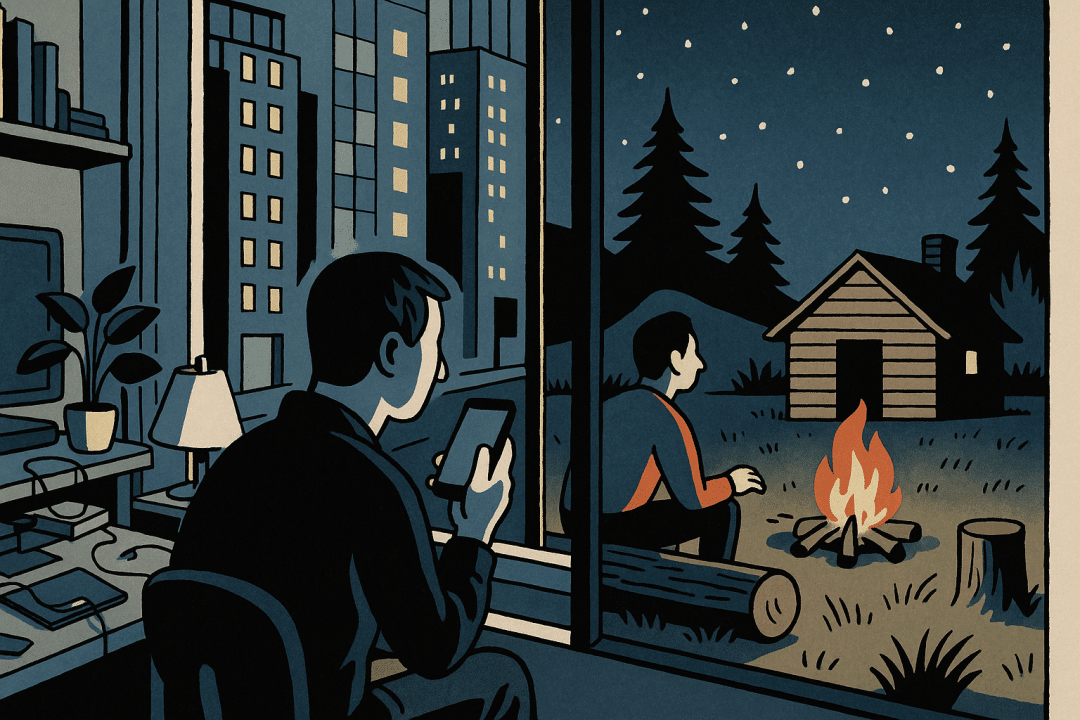
Ever catch yourself dreaming of a quieter era—one where evenings ended around a fire instead of a glowing screen and a single well-made tool served a lifetime? Historians will tell us that age of perfect simplicity never truly existed; every century carried its own noise, its own clutter. Yet nostalgia for that imagined past is powerful fuel. It whispers that somewhere behind the notifications and overstuffed closets lies a life we were built to recognize: spacious, deliberate, and light on possessions.
Rather than dismiss the longing as naïve, we can put it to work. The fifteen “urges” that follow show how to channel nostalgia into concrete choices—curbing debt, pruning calendars, trading algorithms for birdcalls—so the best parts of that idealized past reappear in the present tense. Minimalism, then, becomes less a retreat from modernity and more a reclamation of what we always hoped it could deliver: room to live on purpose.
The urge to vanish from endless feeds and reclaim unposted moments. Begin by scheduling a single evening each week as a “no-signal sabbath”: phones powered down, Wi-Fi off at the router, camera shutter closed. Journal afterward—not online—about what you noticed when no audience was implied. Repetition converts novelty into baseline, and soon the impulse to share everything softens into the pleasure of simply being there.
The urge to taste the depth of doing one thing instead of skimming dozens. Choose one activity—reading a chapter, sanding a board, kneading dough—and give it an unbroken twenty-minute window, timer visible. Distractions that surface get jotted on scrap paper for later; then attention returns to the task like a compass needle to north. Depth becomes addictive once the mind recalls how satisfying singular focus feels.
The urge to stop comparing real days to algorithm-polished highlight reels. Unfollow anyone whose posts consistently trigger envy, then replace that screen time with a walk among uncurated neighbors, pets, and mailbox flags. Reality’s mixed lighting and imperfect angles inoculate against the myth of constant sparkle. Over weeks, your reference point resets from curated pixels to lived textures.
The urge to flee aisles of hyper-choice and live with one trustworthy tool. Identify one category—kitchen knife, backpack, fountain pen—where duplicates breed. Donate or sell the backups, then learn to maintain the survivor: sharpen the blade, oil the leather, clean the nib. Mastery replaces variety as the source of satisfaction, and the store aisle loses its siren call.
The urge to sever debt’s leash so tomorrow’s hours belong to tomorrow. Draft a brutally honest payoff timeline, listing every balance and minimum. Automate the highest-interest payment the day after each paycheck lands, before discretionary spending begins. Tracking progress on a wall chart lets your future feel nearer with every square colored in, turning frugality into a visible march toward freedom.
The urge to lighten your footprint until the planet can exhale again. Start with a one-in, two-out rule for possessions and a meat-free Monday for meals. Measure trash output for a week, then aim to shrink the bag by a quarter next week. Environmental action becomes concrete math—pounds and kilowatts—rather than abstract guilt.
The urge to stand beneath a night sky unbleached by neon and feel cosmic scale. Once a month, drive or bike beyond city glow, bring a blanket, and give the sky an hour with no agenda. A stargazing app can be fun, but try naked-eye orientation first; naming constellations the old way restores a lineage older than electricity. Awe recalibrates petty urgency better than any productivity hack.
The urge to relearn how ancestors thrived on less and felt wealthy in time. Interview an elder relative or read a Depression-era memoir, noting practices that traded money for ingenuity. Choose one—darning socks, making broth from scraps—and fold it into your week. The skill itself matters less than the mindset it revives: resourcefulness over replacement.
The urge to roam “anywhere” for real, unshackled from office-shaped screens. Propose a trial: one workday performed entirely from a library desk, a park bench, or a train seat. Pack tasks that need only a laptop and offline brainpower, then observe how location shift jolts creativity. If bosses allow, expand to a regular cadence that reminds you geography is a choice, not a default.
The urge to trade convenience for meaning, pruning abundance to reveal joy. Conduct a “convenience audit”: list every subscription, gadget, or shortcut purchased in the past year. For each, ask whether it delivers delight or merely speed. Cancel or donate the hollow helpers and reclaim the small frictions—hand-grinding coffee, writing addresses—that slow life enough to taste it.
The urge to replace push notifications with birdcalls and wind in cedars. Install a single daily notification window—say, noon—to check all messages at once, then set the phone to do-not-disturb until the next day. Use the freed minutes to sit on a porch or park bench, naming whatever sounds crest the silence. Attention, like any sense, sharpens when deprived of its usual sugar.
The urge to escape news cycles that solve nothing yet consume everything. Limit headlines to a fifteen-minute slot after lunch, paired with a reputable long-form source once a week. When anxiety still spikes, channel it into a local action—write a representative, volunteer an hour—so information converts to agency rather than helpless scrolling.
The urge to swap subscription fees for skills that make and mend. Cancel one streaming or delivery service and redirect the monthly cost toward a class—sewing basics, bike repair, bread baking. Practicing with your hands rewires buying impulses into creative urges, and the finished product carries a story no algorithm can stream.
The urge to revolt against calendar grids packed so tight spontaneity can’t breathe. Block two consecutive hours every week as “white space” and treat it like a medical appointment—immovable. When it arrives, decide in the moment: nap, phone a friend, wander a bookstore. Empty slots become incubators for whim, which modern life quietly starves.
The urge to own fewer things so there’s room to host bigger questions. Choose one closet or bookshelf and empty it completely onto the floor. Return only the items that serve a clear purpose or spark unmistakable delight. In the physical gap that remains, place a chair or cushion—somewhere to sit, think, and ask what kind of life all this space is meant to hold.
If you enjoyed this article, please support my work by subscribing to my daily newsletter.


