
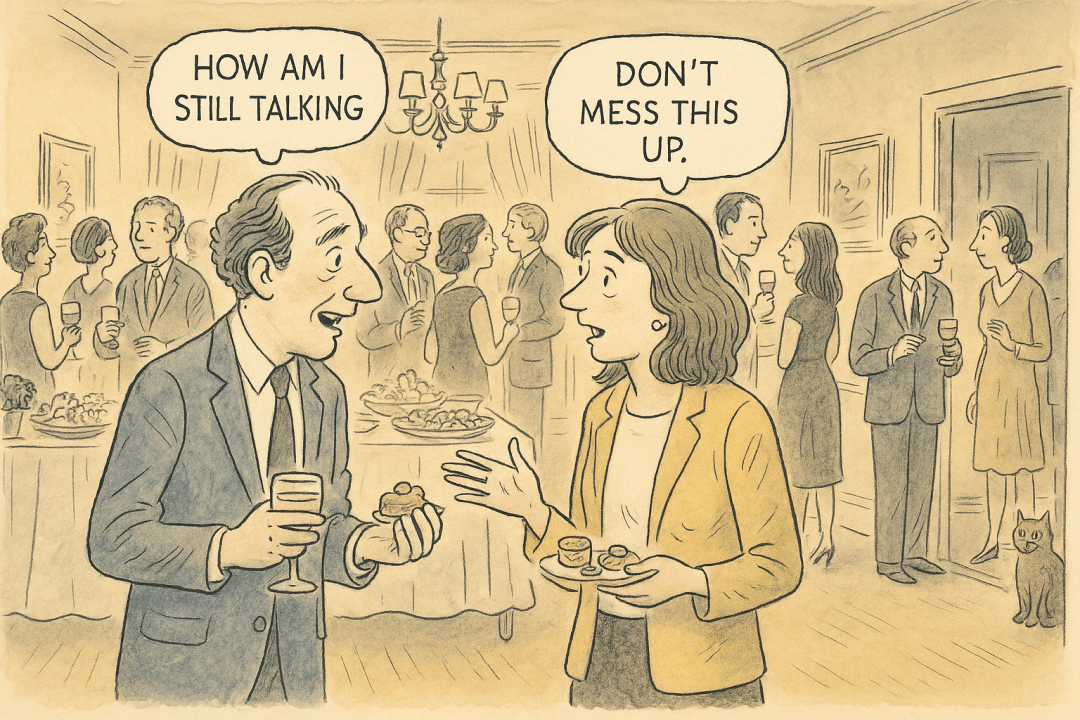
Created by Mike Donghia. Subscribe to our blog for free daily updates.
In every gathering where name-tags are worn, there’s a secret contest under way: who can escape first to the buffet without revealing that they spent the last ninety seconds carefully managing the direction of their gaze to avoid direct eye contact with anyone else.
Small talk, supposedly the low-stakes sport of the socially adept, feels more like a minefield to the rest of us. Yet the evidence is annoyingly clear that exchanging a few banal observations with strangers nudges our mood upward and stitches us more snugly into the fabric of the day.
Gillian Sandstrom and Elizabeth Dunn, for example, have shown that fleeting “weak-tie” chats correlate with a spike in happiness, even among introverts who swore they’d rather wrestle an alligator than discuss the weather. So the question isn’t whether small talk matters, but how to do it without feeling as if you’re auditioning for The Office.
These seven ideas re-surface whenever I venture into the conversational shallow end; they won’t make you the life of the party, but they might save you from hiding behind the potted fern.
Begin with the scenery, not the selfie – because the world is already handing you your opening line. We fret about “what to say” as though we were playwrights tasked with dazzling dialogue, when the real art is simply noticing. Temperature, queue length, suspiciously green canapé: anything both people can see is fair game. Treat the shared environment as a prompt card and you’ll avoid the cardinal error of talking about yourself too soon. This isn’t narcissism; it’s neuroscience. The anxious brain shrinks its attentional spotlight to the self, so forcing it outward gives your sympathetic system somewhere else to look. A trivial remark about the venue is a psychological stretch-exercise: easy, low-impact, and it warms you up for deeper moves.
Assume the other person will like you – they probably will. Social psychologists call it the “liking gap”: after brief conversations we routinely underestimate how positively we’ve been received. Participants in one frequently replicated study expected to be judged as awkward; instead, partners rated them warm and interesting. Running on the opposite assumption – that your new acquaintance is poised to pounce on any awkward pause – makes you defensive, which all but guarantees the outcome you fear. Quietly wager on their goodwill and your tone softens, your questions broaden, and the gap closes without effort.
Take the curiosity dividend – questions beat statements nine times out of ten. The mathematician John Tukey advised “being approximately right rather than precisely wrong.” In small talk, questions are approximate: you float a possibility about the other person’s world rather than declaring your own. Good questions are neither job-interview interrogations nor cheating fridge-magnet affirmations (“What’s your passion?”), but modest invitations: “How did you end up in pediatric neurology?”; “What’s the story behind that lapel pin?” The point isn’t information extraction; it’s demonstrating that you’re prepared to be enlarged by their answer. Ask a follow-up and you’ve already done more listening than most of their day has offered.
Treat nods, laughs and hmm-noises as your real contribution – words are a bonus. Conversation is a duet in which silence has a beat. If you’re worried about dominating or, conversely, about drying up, shift your metric: your job is to supply signals that keep the joint rhythm alive. Linguists call this “back-channeling,” and it matters because it releases your partner from the fear of boring you. Once that fear subsides, they become more interesting – which takes further pressure off you. (Should you doubt the power of a well-timed “right?”, observe two commuters on a delayed train commiserating over nothing and emerging as comrades.)
Remember that small talk is a bridge, not a destination – exit gracefully when you get to the other side. We endure excruciating codas because we believe conversations, like films, must end with a moral or a wedding. Nonsense. Small talk ends when its work is done: you’ve established enough rapport to swap emails, or confirmed that neither of you requires the other’s email. A simple “I’m going to grab another coffee – lovely chatting” does the trick. Depart one beat earlier than comfort dictates and you’ll feel braver next time.
Let benign gossip do the heavy lifting – but aim it upward, not sideways. Speaking ill of the absent is corrosive, yet speaking well of the absent is conversational rocket fuel. Praising the absent third party (“Javier designed this app – he’s frighteningly good”) supplies content, flatters your listener by association, and signals that you’re a safe repository for their own reputation. Sociologist Gabriel Goodman calls this “pro-social gossip,” and it lubricates groups far better than another weather report. Just keep it specific and sincere; general flattery smells of desperation.
End on an offer, however tiny – because generosity lingers longer than wit. “Let me email you that podcast episode,” or “If you’re ever in Asheville, try the bakery on Walnut Street,” are not mere pleasantries; they’re micro-commitments that transform a transient chat into the first pixel of a relationship. Behavioral scientists note that even token helpfulness triggers reciprocity norms, nudging future encounters onto a friendlier footing. And if you never cross paths again, you’ve still deposited a glint of usefulness into the social commons – which, given how many of our interactions are extractive, feels mildly subversive.
Small talk won’t land you a book deal or solve systemic inequality, but it will do something rarer: remind you, in increments too small for your ego to hijack, that other people are enduring the same séance of self-doubt behind their polite smiles. Each throwaway chat is a postcard from that shared predicament, signed with the quiet reassurance that you are less alone than you feared. And that, frankly, is a lot of consoling mileage for the price of remarking on the guacamole.
If you enjoyed this article, please support my work by subscribing to my daily newsletter.


