
Created by Mike Donghia. Subscribe to our blog for free daily updates.
Welcome to Ask Mike, a regular column on our blog where I give a friendly, but opinionated answer to reader questions. Today, I’ll be answering the following question:
“What’s the Difference Between Rest and Escape?”
Dear Reader,
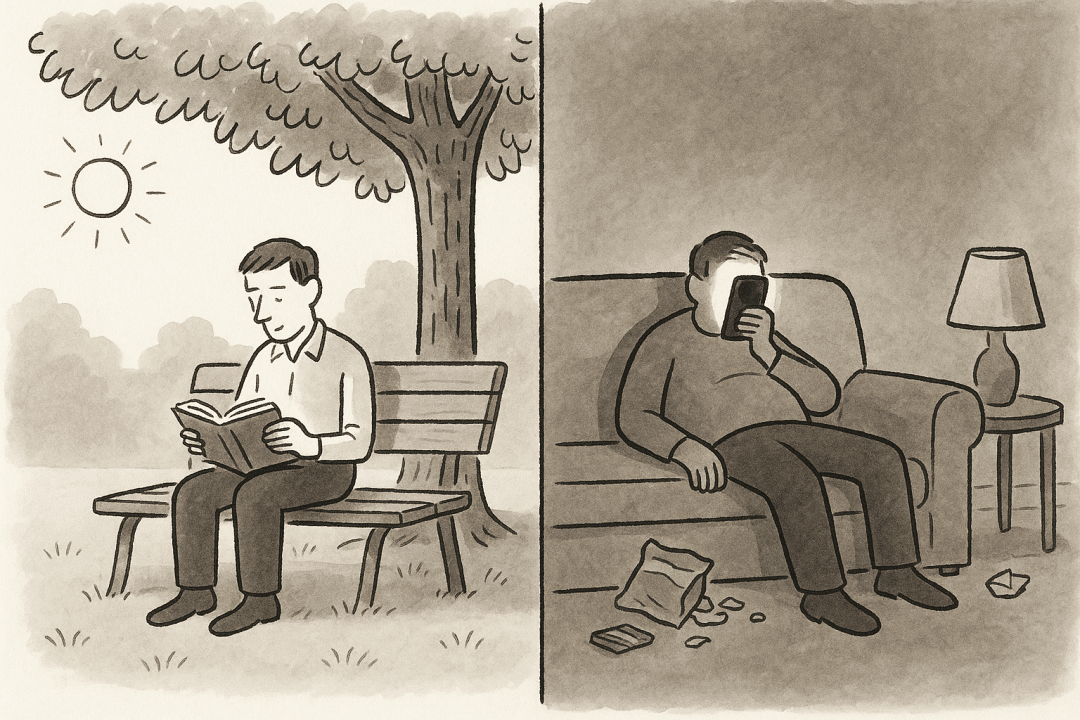
The line between true rest and mere escape looks thin only when you’re exhausted. Rest is engagement with life at a humane speed; escape is flight from life at any speed. Rest leaves you lighter, clearer, and able to return to your responsibilities with fresh attention. Escape leaves you unchanged—or worse, a little dulled—so the same demands feel heavier when you come back.
Think of rest as nutrition for attention. It supplies what intense work depletes: sleep, unhurried conversation, a walk that ends nowhere in particular, prayer, a hobby pursued for its own sake. These acts replenish cognitive and emotional glycogen. The mind stays awake inside them. You notice small delights, hear your own thoughts, maybe even feel boredom edge in—and that’s fine, because boredom is just your brain gearing down so it can idle and repair.
Escape, by contrast, is novocaine for attention. It numbs without healing: endless scrolling, binge-watching shows you barely like, reflexive snacking, anything chosen primarily because it erases self-awareness. The tell-tale symptom is dissociation. Hours vanish, your posture collapses, and when the spell breaks you feel both restless and strangely tired. That “hangover” is your nervous system reminding you it never got the maintenance it needed.
Here’s a field test I use. Before the activity, ask: Will this make future-me stronger, clearer, or kinder? If the honest answer is yes, you’re choosing rest. If the answer is “It’ll just shut me up for a while,” you’re opting for escape. Afterward, run a second test: Do I feel more available for the people and projects that matter? Rest produces an upward tick in readiness; escape produces a dip, or at best a flat line.
Of course, the same behavior can land on either side of the line. A movie night with friends can be soulful rest, a solo five-episode spell can be escape. What matters is intention plus awareness. Schedule downtime the way you schedule work: explicitly, in advance, with a start and stop. Ritualize it—tea before reading, shoes by the door before the walk—so your body knows what’s coming. During the activity, keep tiny interrupts: stretch, jot a thought, glance out the window. These momentary check-ins prevent the slide from restorative immersion to mindless displacement.
Finally, remember that rest is an investment, not a reward you must earn. Treat it as infrastructure: the quiet bridge that lets tomorrow’s effort cross the river. Escape feels cheaper because it asks nothing upfront, but the bill arrives later as irritability, insomnia, or creative drought. Pay the cost in attention now, and rest will pay you back in compounded clarity.
Choose rest on purpose; refuse escape by default. Your future-you will notice the difference—and so will everyone who depends on you.
Your friendly, but opinionated friend,
Mike
If you enjoyed this article, please support my work by subscribing to my daily newsletter.